

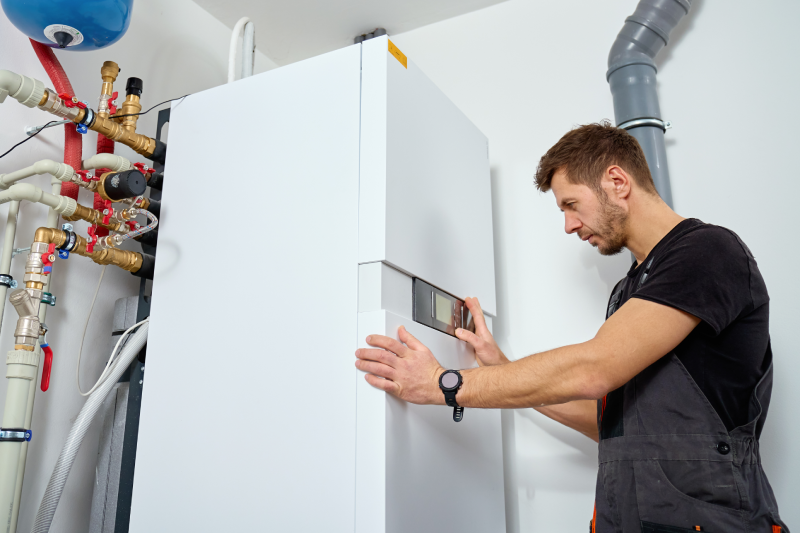
Set most household water heaters to 120°F. The U.S. Department of Energy recommends 120°F as the best water heater temperature for balancing comfort, safety, and energy savings. It lowers scald risk and slows mineral buildup while staying hot enough for daily use. Homes with immune-compromised residents may store hotter and add a mixing valve to manage Legionella.
The water heater temperature recommendation most homeowners should follow is 120°F, but the right setting depends on your household and your priorities. This guide explains the ideal water heater setting, the safety and energy tradeoffs, how to adjust the thermostat setting, and why Salt Lake City’s hard water makes the right temperature matter even more.
What Is the Best Water Heater Temperature?
For most homes, 120°F is the best water heater temperature. The U.S. Department of Energy recommends 120°F because it provides comfortable hot water while reducing energy waste and scald risk, and DOE notes a 140°F setting can waste $36 to $61 a year in standby heat loss alone (Source: U.S. Department of Energy). At 120°F you get a safe water heater temp for daily showers, dishes, and laundry without the burns or waste that come with a hotter tank.
The 120°F vs 140°F Tradeoff
The temperature debate comes down to three concerns: safety, energy savings, and bacteria.
| Setting | Pros | Cons |
|---|---|---|
| 120°F | Lower scald risk, energy savings, less sediment and corrosion | Slight Legionella risk for vulnerable people |
| 130°F | Middle ground | Slower to control Legionella, higher scald risk than 120°F |
| 140°F | Controls Legionella bacteria | Higher scald risk, more energy use, faster mineral buildup |
The U.S. Centers for Disease Control and Prevention notes that Legionella bacteria grow in warm water and recommends storing hot water above 140°F to control them, while using thermostatic mixing valves at fixtures to deliver water at a safe temperature and prevent scalding (Source: Centers for Disease Control and Prevention). In other words, you can store hotter for bacteria control and still deliver water at a safe 120°F at the tap.
For most healthy households, 120°F is the right call. If someone in the home has a weakened immune system or chronic respiratory illness, talk with a plumber about storing at 140°F with a mixing valve.
Why the Right Temperature Matters in Salt Lake City
Salt Lake City has notably hard water. Local supply is commonly very hard, around 13 grains per gallon, which the U.S. Geological Survey classifies as very hard (Source: U.S. Geological Survey). Those dissolved minerals drop out of solution faster at higher temperatures, so a tank cranked to 140°F builds sediment at the bottom more quickly than one at 120°F. That sediment insulates the burner, lowers efficiency, and shortens tank life. Keeping the thermostat setting at 120°F is one of the simplest ways to slow that buildup in hard-water homes.
How to Adjust Your Water Heater Temperature
- Find the thermostat. On a gas heater it is a dial near the bottom. On an electric heater there are usually two thermostats behind access panels (turn off the breaker first).
- Test the current temperature. Run the hot tap nearest the heater for a minute and measure with a thermometer.
- Adjust in small steps. Turn the dial toward 120°F, then wait a few hours and retest.
- Confirm at the tap. Aim for about 120°F at the fixture, not just at the tank.
- Recheck after a day. Fine-tune until it holds steady.
If you have an older heater with no anti-scald protection, or you want to store hotter for Legionella control, have a plumber install a mixing valve so the delivered temperature stays safe.
More Questions Homeowners Ask
Is 120 or 140 degrees better for a water heater?
For most homes, 120°F is better for safety and energy savings. 140°F controls Legionella but raises scald risk and energy use, so it is usually paired with a mixing valve.
Does lowering the temperature really save energy?
Yes. Reducing the setting lowers standby heat loss, which is why the DOE recommends 120°F for energy savings (Source: U.S. Department of Energy).
What temperature prevents scalding?
At 120°F it takes much longer for water to cause a serious burn than at 140°F, which is why 120°F is the standard safe water heater temp for homes with children or older adults.
Why does my water heater build sediment so fast?
Salt Lake City’s hard water. Minerals settle faster at higher temperatures, so a lower setting and regular flushing slow the buildup.
Should I turn the temperature down when I travel?
Lower it or use a vacation setting, but do not turn it off in a way that lets the tank cool into the Legionella growth range for long periods. Flush the taps when you return.
Key Facts at a Glance
- The U.S. Department of Energy recommends 120°F for most households, for safety and energy savings (Source: U.S. Department of Energy).
- The CDC recommends storing hot water above 140°F to control Legionella, with mixing valves to prevent scalding (Source: Centers for Disease Control and Prevention).
- 120°F lowers scald risk and slows sediment and corrosion.
- Salt Lake City’s very hard water, around 13 grains per gallon, builds sediment faster at higher temperatures (Source: U.S. Geological Survey).
- Adjust the thermostat in small steps and confirm about 120°F at the tap.
- A mixing valve lets you store hotter while delivering safe water.
Set It Right and Protect Your Water Heater in Salt Lake City
For most Salt Lake City homes, 120°F is the answer: safe, efficient, and easier on a tank fighting hard water. If you want to store hotter for health reasons, or your heater is overdue for a checkup, a licensed plumber can set it up safely.
Hale Home Services has served Salt Lake City homeowners for over a decade with licensed plumbers and 24/7 availability. Call 385-853-7378 or visit our water heater repair page to have your temperature, anode, and sediment checked.
Keep reading:
