

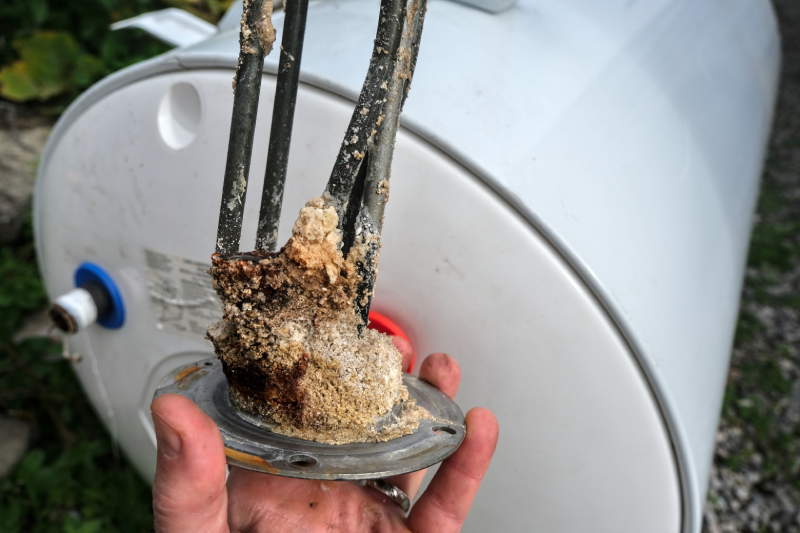
Replace your water heater anode rod when more than about 6 inches of the inner steel wire is exposed, the rod is under roughly half an inch thick, or it is heavily pitted. In Salt Lake City’s very hard water, inspect the rod every 2 to 3 years. A timely swap (a $20 to $60 part) can prevent a $1,200 or higher tank replacement.
If you own a standard tank water heater in Salt Lake City, one inexpensive metal rod is quietly deciding how long that tank lasts. It is called the sacrificial anode rod, and it is built to corrode so the steel tank does not. Once it is used up, rust moves to the tank walls, and a slow pinhole leak or a sudden rupture is usually next.
Why This Matters More in Salt Lake City
National “replace it every few years” advice does not account for your water. Salt Lake City sits in one of the country’s hard-water belts. Local supply blends mineral-rich runoff from the Wasatch canyons with deep valley wells, and the city notes that its well water runs harder, carrying more minerals, than its surface sources (Source: [Salt Lake City Department of Public Utilities]). That water is commonly measured in the very hard range, around 13 grains per gallon. The U.S. Geological Survey classifies anything above roughly 10.5 grains per gallon (180 mg/L) as very hard (Source: [U.S. Geological Survey]).
Hardness is not a health concern, which is why the U.S. Environmental Protection Agency treats it only as a non-enforceable, aesthetic secondary standard rather than a regulated limit (Source: [U.S. Environmental Protection Agency]). For your water heater, though, those minerals are exactly what wears the anode rod down faster.
Hard, mineral-loaded water is harder on the components inside your tank. It speeds sediment buildup and changes how quickly the anode is consumed. If a household also runs a water softener, the softened water becomes more aggressive toward the rod and can burn through it noticeably faster. The result: in many Salt Lake Valley homes, an anode that a manufacturer rates for several years is effectively spent sooner.
The payoff for staying ahead of it is large. The U.S. Department of Energy puts the average lifespan of a storage tank water heater at about 15 years, and lists inspecting the anode rod as core routine maintenance (Source: [U.S. Department of Energy]). A maintained rod is one of the few things that reliably pushes a tank toward the upper end of that range instead of failing early. That is why timely water heater anode rod replacement is the cheapest insurance a Salt Lake County homeowner can buy for a tank that runs on very hard water.
What Is a Water Heater Anode Rod?
A water heater anode rod is a long metal rod, threaded into the top of your tank, that corrodes on purpose to protect the steel tank from rust. It is usually magnesium, aluminum, or an aluminum-zinc alloy formed around a steel core wire.
The science is simple galvanic corrosion (electrolysis). The rod’s metal is more chemically active than the tank’s steel lining, so corrosive elements in the water attack the rod first. Plumbers call it the “sacrificial” anode because it gives itself up to spare the tank. When the rod is gone, that protection ends and the tank itself becomes the target.
In plain terms, the rod is the heart of water heater rust prevention. As long as it has metal left to give, tank corrosion is held off. Once it is spent, the steel walls start rusting from the inside, which is why the sacrificial anode rod is the single part most worth tracking.
How Do You Know Your Anode Rod Needs Replacing?
Replace the anode rod when inspection shows heavy corrosion, exposed core wire, or the rod worn down to a thin remnant. Warning signs you can notice without opening the tank include rusty or discolored hot water, a rotten-egg (sulfur) smell, and popping or rumbling from the tank.
Watch for these signals:
- Rusty or metallic hot water: Cold water runs clear, but hot water looks tinted. This often means the rod is depleted and the tank has started to corrode.
- Rotten-egg smell: A sulfur odor in hot water usually points to a reaction at a magnesium rod. Switching rod material commonly resolves it.
- Popping or rumbling sounds: Sediment hardening at the tank bottom, made worse by hard water, often arrives alongside a worn rod.
- Age past 3 years with no inspection: In hard water, that is already overdue for a look.
If hot water is discolored or smells off, route a check to a Salt Lake City water heater technician rather than waiting for a leak.
How Often Should You Inspect the Anode Rod in Salt Lake City?
Inspect the anode rod every 2 to 3 years in Salt Lake City, and once a year if your home uses a water softener. Federal guidance lists anode inspection every 3 to 4 years as a baseline, but that assumes average water. Local hardness shortens the safe interval (Source: [U.S. Department of Energy]).
A practical local schedule:
- No softener, city water: Inspect every 2 to 3 years.
- Water softener in use: Inspect every 12 months, since softened water corrodes the rod faster.
- Tank already 6 years or older with unknown history: Inspect now.
Magnesium vs Aluminum vs Powered Anode Rods: Which Is Right for Hard Water?
For Salt Lake City’s hard water, an aluminum-zinc rod or a powered (impressed-current) anode usually lasts longer than standard magnesium, while magnesium gives the strongest protection where water is less aggressive. Use this comparison to decide:
| Anode Type | Best For | Typical Lifespan in Hard Water | Notes |
|---|---|---|---|
| Magnesium | Strong protection, moderate water | 1 to 4 years | Best corrosion protection; depletes faster in hard or softened water; can cause sulfur smell |
| Aluminum / Aluminum-Zinc | Hard water, longer intervals | 4 to 6 years | Lasts longer in mineral-heavy water; zinc helps reduce rotten-egg odor |
| Powered (Impressed-Current) | “Set and forget,” recurring odor | Often the life of the tank | No sacrificial metal to replace; needs an outlet; unprotected during power outages |
A licensed plumber can match the rod to your exact water and tank so you are not guessing on material.
5 Factors That Decide How Fast Your Anode Rod Wears Out
The rate of anode rod corrosion is not the same in every home, so a generic replacement interval can leave your tank exposed. Five local factors drive how fast the rod is consumed:
- Water hardness: The more dissolved calcium and magnesium, the faster corrosion runs. Salt Lake City’s very hard water sits at the demanding end (Source: [U.S. Geological Survey]).
- Water softener use: Softened water is more conductive and consumes the rod faster, often cutting its life in half.
- Water temperature: Higher tank settings accelerate corrosion. The U.S. Department of Energy suggests 120 degrees Fahrenheit for efficiency and reduced wear (Source: [U.S. Department of Energy]).
- Water chemistry: Chlorine levels, acidity, and naturally occurring sulfates all change how quickly the rod degrades.
- Hot water usage: More daily draw means more fresh, mineral-bearing water cycling through the tank.
How to Replace a Water Heater Anode Rod (Step by Step)
To replace a water heater anode rod, cut the power, shut the cold-water inlet, drain a few gallons, unthread the old rod from the top port with a 1 1/16 inch socket, then thread in the new rod with fresh plumber’s tape. Use this checklist to inspect first and decide between a quick rod swap and a service call:
- Confirm tank age (check the manufacturer label or serial number).
- Note any rusty, cloudy, or smelly hot water.
- Listen for popping or rumbling during a heating cycle.
- Cut power: flip the breaker (electric) or set gas to pilot.
- Shut the cold-water inlet valve.
- Drain 2 to 3 gallons to drop the level below the rod port.
- Locate the anode port (often a hex head on top, sometimes under a plastic cap or doubling as the hot-water outlet).
- Loosen with a 1 1/16 inch socket and a breaker bar, then inspect.
- Replace if the core wire is exposed beyond about 6 inches or the rod is thin and pitted.
If the rod is seized, the port is hidden, or you would rather not drain a heavy tank, that is the point to call a pro. Hidden caps and over-tightened factory rods make this job harder than online videos suggest.
Myth: A Glass-Lined Tank Does Not Need an Anode Rod
Is a glass-lined or “lifetime” tank rust-proof without an anode rod? No. The glass lining slows corrosion but is not flawless. Tiny imperfections and the bare steel at fittings still need the anode’s protection. Without a working rod, even a premium glass-lined tank can corrode and fail well before its tenth year. The lining and the anode work together, not as substitutes.
Replace the Rod or Replace the Heater? A Quick Cost Comparison
| Decision | Typical Cost | When It Makes Sense |
|---|---|---|
| Replace the anode rod | $20 to $60 part; installed | Tank under 10 years, no active leak, sound walls |
| Replace the water heater | $1,200 or higher installed (varies by size and fuel) | Active tank leak, tank past 12 years, or repeated failures |
The takeaway: a timely rod is inexpensive insurance against a far larger replacement.
More Questions Homeowners Ask
Can I replace an anode rod myself?
Yes, if you can safely cut power, drain partially, and break loose a tight rod. Many Salt Lake City tanks have hidden ports or seized rods, so a professional swap is often faster and avoids damaging the tank top.
Does a water softener mean I do not need an anode rod?
No. A softener does the opposite: softened water speeds rod corrosion, so the rod matters more and should be checked yearly.
Will replacing the anode rod fix a rotten-egg smell?
Often, yes. The smell usually comes from a magnesium rod reacting in your water. Switching to an aluminum-zinc or powered anode commonly clears it.
How long does an anode rod last?
Anywhere from 1 to 6 years depending on material and water. In hard or softened Salt Lake City water, expect the shorter end.
Do tankless water heaters have anode rods?
Most tankless units do not, so they do not need this service. They have different maintenance needs, mainly descaling in hard water.
Is anode rod replacement covered by my water heater warranty?
The rod is a wear item. Skipping inspection can void tank warranties, since corrosion from a depleted rod is treated as a maintenance failure. Keep records of service.
Key Facts at a Glance
- Salt Lake City water is commonly very hard, around 13 grains per gallon (above the 10.5 grain very-hard threshold) (Source: [U.S. Geological Survey]).
- Average storage tank water heater lifespan is about 15 years (Source: [U.S. Department of Energy]).
- Federal guidance lists anode inspection every 3 to 4 years as a baseline; hard water shortens that to every 2 to 3 years (Source: [U.S. Department of Energy]).
- A new anode rod is roughly a $20 to $60 part versus $1,200 or higher for a full tank.
- A water softener can cut anode rod life roughly in half.
- 120 degrees Fahrenheit is the recommended tank temperature for efficiency and reduced corrosion (Source: [U.S. Department of Energy]).
Protect Your Salt Lake City Tank Before It Leaks
A spent anode rod is the quiet reason many water heaters fail years early. If your tank is past 2 to 3 years since the last check, or you have noticed rusty water, a sulfur smell, or rumbling, a quick inspection now can add years to the unit.
Hale Home Services has served Salt Lake City homeowners for over a decade with licensed plumbers and 24/7 emergency availability. Call 385-853-7378 or contact us online to schedule water heater anode rod replacement, from inspection to a new rod installed.
Keep reading:
- Water heater repair and replacement in Salt Lake City
- Drain cleaning services
- About Hale Home Services
