

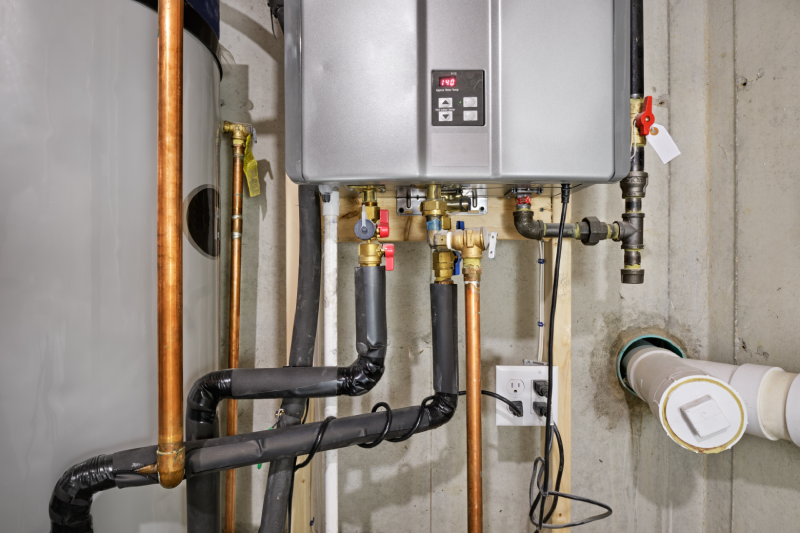
A tankless water heater heats water on demand, saves space, and lasts 20 years or more, but costs more to install. A tank water heater is cheaper upfront and lasts about 10 to 15 years. For most Salt Lake City homes, the choice depends on budget, hot water demand, and how long you plan to stay.
Choosing between a tankless and a tank water heater is one of the bigger plumbing decisions a homeowner makes, and the right answer is not the same for every house. This guide breaks down the tankless vs tank water heater decision by cost, lifespan, energy efficiency, and the two things Salt Lake City homeowners should weigh that most national guides skip: hard water and cold winters.
How Each Type Works
A tank (storage) water heater keeps 30 to 50 gallons of water hot at all times, ready to use. A tankless, or on demand water heater, has no tank and heats water only as it flows through the unit. When you open a hot tap, cold water passes through a gas burner or electric element and is heated on the spot.
That core difference drives everything else in the storage vs tankless comparison. A storage tank loses some heat around the clock just keeping the water warm, which the U.S. Department of Energy calls standby loss. A tankless unit avoids that loss but is limited by its flow rate, meaning there is a cap on how many gallons per minute it can heat at once (Source: U.S. Department of Energy).
Tankless vs Tank Water Heater: Side-by-Side Comparison
| Factor | Tank (Storage) | Tankless (On Demand) |
|---|---|---|
| Upfront installation cost | Lower | Higher |
| Typical lifespan | 10 to 15 years | 20 years or more |
| Energy efficiency | Loses standby heat | 8 to 34 percent more efficient |
| Space used | Large floor footprint | Compact, wall-mounted |
| Hot water supply | Limited to tank size | Continuous, capped by flow rate |
| Salt Lake City maintenance | Flush yearly for sediment | Descale yearly for scale |
| Best for | Lower budget, simple swap | Long-term owners, space savings |
Lifespan and efficiency figures: U.S. Department of Energy.
Tankless Water Heater Pros and Cons
For the tankless water heater pros and cons, here is the honest picture.
Pros:
- Heats only when needed, so it avoids standby loss and runs more efficiently.
- Lasts 20 years or more, often double a storage tank (Source: U.S. Department of Energy).
- Compact and wall-mounted, freeing up floor space.
- Continuous hot water for back-to-back use, as long as demand stays within the unit’s flow rate.
Cons:
- Higher installation cost, often needing gas line, venting, or electrical upgrades.
- Output is capped by flow rate, so heavy simultaneous demand can outpace a single unit.
- Needs electricity to run, so a power outage means no hot water, even on gas models.
- In hard water, it needs annual descaling to protect efficiency and unit lifespan.
Tank (Storage) Water Heater Pros and Cons
Pros:
- Lower upfront and installation cost.
- Simple, fast replacement when an existing tank fails.
- Delivers a large burst of hot water for simultaneous demand, up to the tank’s capacity.
- Keeps working during a power outage on gas models with a standing pilot.
Cons:
- Loses standby heat around the clock, lowering energy efficiency.
- Runs out during heavy use and needs time to reheat.
- Shorter lifespan of about 10 to 15 years (Source: U.S. Department of Energy).
- Takes up significant floor space.
Tank vs Tankless Cost
On tank vs tankless cost, a storage tank is cheaper to buy and install, while a tankless unit costs more upfront but can lower energy bills and last far longer. Installation cost is usually the deciding factor for homeowners.
| Cost Element | Tank (Storage) | Tankless (On Demand) |
|---|---|---|
| Typical installed cost | $1,200 to $2,500 | $3,000 to $5,500 |
| Annual operating savings vs tank | Baseline | Roughly $44 to $100 plus per year |
| Lifespan | 10 to 15 years | 20 years or more |
Operating-savings range: U.S. Department of Energy. Installed-cost ranges are typical market figures.
Because a tankless unit lasts about twice as long, the higher installation cost is spread over far more years of service. The longer you plan to stay in the home, the more that math favors tankless.
Energy Efficiency: How Much Does Tankless Really Save?
For homes that use 41 gallons or less of hot water per day, a tankless water heater can be 24 to 34 percent more energy efficient than a storage tank. For homes using around 86 gallons a day, the gain is 8 to 14 percent (Source: U.S. Department of Energy). Installing a unit at each major hot water point can push savings higher still.
The savings come from eliminating standby loss. A storage tank reheats the same water all day to fight that loss, while a tankless unit sits idle until you need it. For a Salt Lake City household weighing energy efficiency against upfront cost, that ongoing saving is the long-term payoff that offsets the higher installation cost.
The Salt Lake City Hard Water Factor
This is where local conditions tip the decision, and most national guides miss it. Salt Lake City blends mineral-rich runoff from the Wasatch canyons with deep wells across the Salt Lake Valley, and the city notes its well water runs harder than its surface sources (Source: Salt Lake City Department of Public Utilities). Local water is commonly very hard, around 13 grains per gallon, which the U.S. Geological Survey classifies as very hard (Source: U.S. Geological Survey).
Hard water affects both types. A storage tank needs a yearly flush to clear sediment; a tankless unit needs a yearly descale to clear scale from the heat exchanger. Skipping that maintenance shortens unit lifespan and cuts efficiency for either one. Utah’s cold winter groundwater matters too: the colder the incoming water, the harder a tankless unit works to raise it to temperature, which lowers the gallons per minute it can deliver at once. Correct sizing for local winter conditions is exactly the kind of call a licensed Salt Lake City plumber should make.
Myth: Tankless Means Instant Hot Water at the Tap
Does tankless mean instant hot water? Not exactly. A tankless unit gives an endless supply, but the hot water still has to travel from the unit to your faucet, so there is the same brief wait you get with a tank. “On demand” means it never runs out, not that it arrives the instant you open the tap. A recirculation pump is what gets you near-instant hot water, and it can be added to either system.
Which Is Right for You?
- Choose a tank water heater if you want the lower upfront cost, you are replacing a failed unit quickly, or you plan to move within a few years.
- Choose a tankless water heater if you plan to stay long term, want lower energy bills and a longer lifespan, need to reclaim space, or want continuous hot water for a busy household.
- Either way, correct sizing and a code-compliant install matter more than the brand, and the U.S. Department of Energy specifically recommends a qualified contractor for gas units (Source: U.S. Department of Energy).
More Questions Homeowners Ask
Is a tankless water heater worth it in Salt Lake City?
For long-term owners, often yes, thanks to lower energy use and a 20-year-plus lifespan. Just budget for annual descaling because of the hard water.
Do tankless water heaters run out of hot water?
Not by volume, but they are capped by flow rate. Too many fixtures at once can outpace a single unit, which is why correct sizing matters.
Does a tankless water heater work during a power outage?
No. Even gas tankless units need electricity for ignition and controls, so an outage stops hot water. A gas tank with a standing pilot can keep working.
How long does each type last?
A storage tank lasts about 10 to 15 years; a tankless unit typically lasts 20 years or more with maintenance (Source: U.S. Department of Energy).
Is tankless harder to maintain in hard water?
It needs annual descaling, while a tank needs annual flushing. Both require upkeep here; neither is maintenance-free in Salt Lake City water.
Can I switch from a tank to tankless?
Yes, but it often involves gas line, venting, or electrical upgrades, which is why the installation cost is higher. A local assessment will tell you what your home needs.
Key Facts at a Glance
- A tankless water heater can be 24 to 34 percent more efficient for low-use homes, and 8 to 14 percent for high-use homes (Source: U.S. Department of Energy).
- Tankless units typically last 20 years or more; storage tanks last about 10 to 15 years (Source: U.S. Department of Energy).
- Tankless avoids standby heat loss but is limited by flow rate.
- Salt Lake City water is commonly very hard, around 13 grains per gallon (Source: U.S. Geological Survey).
- Tanks need yearly flushing; tankless units need yearly descaling in hard water.
- The U.S. Department of Energy recommends a qualified contractor install gas units.
Find the Right Water Heater for Your Salt Lake City Home
The tankless vs tank water heater choice comes down to your budget, your household’s hot water demand, and how long you plan to stay. The best way to decide is a sizing conversation with a local plumber who knows Salt Lake City water and winters.
Hale Home Services has served Salt Lake City homeowners for over a decade with licensed plumbers and 24/7 emergency availability. Call 385-853-7378 or contact us online to talk through water heater installation and replacement and get a recommendation sized for your home.
Keep reading:
